There is a category of decision-makers who no longer need to be sold on anything.
They have assets in multiple jurisdictions. They have advisors (legal, financial, family office) and they’ve done the work. What they’re looking for now isn’t opportunity in the conventional sense. It’s alignment. They want a place that reflects how they actually live, protects what they’ve built, and requires very little explanation to those who know what they’re looking at.
In 2026, more of those individuals are arriving and buying property in the Cayman Islands. Not because Cayman is new. Quite the opposite.
The question isn’t where to invest in real estate. It’s where to anchor.
Dubai and UAE attract capital. Miami attracts culture. Cayman attracts something harder to manufacture: quiet confidence.
The distinction matters when you’re not chasing yield but securing legacy. When your concern is less about the next market cycle and more about where your family spends the next twenty years. When the asset isn’t just the property, it’s the jurisdiction itself.
This blog examines why, in my opinion, globally mobile individuals with significant capital are choosing Cayman over two of its most prominent competitors and what that choice actually means in practice.
Cayman versus Dubai: Governance, privacy, and the limits of spectacle
Dubai’s ascent has been remarkable. In the space of two decades, it has built a global city from the desert, and attracted billions in international capital to a property market that barely existed before this century. For a certain kind of investor, that velocity is the appeal.
But velocity and stability are different things.
On privacy and discretion
Dubai’s property registry is publicly accessible. Ownership records are searchable. For those who move in high-visibility circles, or who simply prefer their property affairs to remain their own, this creates a structural constraint that no amount of luxury development can resolve.
The Cayman Islands offers a different architecture entirely. Ownership can be structured through trusts or corporate entities in ways that provide meaningful privacy protections. It isn’t a loophole; it’s a jurisdiction that has built its legal framework around the legitimate expectations of internationally mobile principals. For families who have spent decades managing their affairs with discretion, the distinction is not minor.
On regulatory maturity
Dubai’s regulatory environment has evolved at pace with its skyline. That’s both its strength and its complexity. Visa frameworks, ownership rules, and broader policy have shifted repeatedly over the past decade, and the direction of travel isn’t always easy to anticipate.
Cayman’s legal and regulatory foundation is rooted in English common law and has been refined (incrementally, deliberately) over more than half a century. Policy changes are rare, and when they occur, they are telegraphed and consultative. For capital that is placed with a generational horizon, that predictability has a value that doesn’t appear in any yield calculation.
On geography and access
Dubai’s position as a hub between East and West is genuine. But for principals whose primary relationships, families, and interests are concentrated in the Americas, it is a long way from anywhere that matters day-to-day.
Cayman sits just over an hour from Miami by direct flight, with regular service to New York, Chicago, Toronto, and Houston. For those who divide time between jurisdictions, proximity is not a luxury, it’s a practical requirement. Cayman offers the removal of a separate jurisdiction without the friction of genuine distance.
On lifestyle
Dubai rewards visibility. It is designed to be noticed: the scale, the architecture, the sheer ambition of it is meant to impress. For a certain chapter of life, that is exactly right.
Cayman operates on a different vibe. Seven Mile Beach is not performing for anyone. The gated communities and private estates that define the island’s top-end market are not built for spectacle; they’re built for those who have already moved past it. Mornings on the water, genuine community, world-class international schools, medical infrastructure, and the kind of anonymity that only comes from being somewhere that doesn’t try too hard These are the hallmarks of the Cayman lifestyle for those at the top of the market.
Cayman versus Miami: Jurisdictional independence and long-term calculus
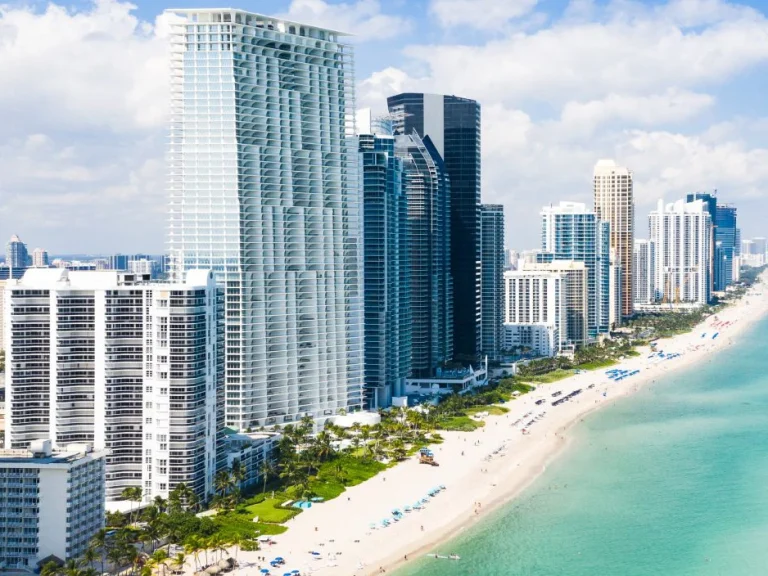
Miami has been the default entry point for international capital entering the United States for decades. Its cultural weight, professional infrastructure, and geographic position are real advantages. For those seeking integration into the US market and its networks, it remains a serious option. But integration into the US system is also exposure to it.
On political and jurisdictional risk
Miami’s fortunes move with US federal policy. Estate planning, residency status, reporting obligations, and ownership rights are all subject to domestic political cycles, and in 2026, those cycles are more volatile than at any point in recent memory. For international buyers who have worked carefully to maintain diversified jurisdictional exposure, placing a primary asset inside the US system requires clear-eyed consideration of what that entails.
The Cayman Islands is a British Overseas Territory with its own government, its own legal system, and meaningful policy independence. It maintains strong institutional relationships with both the United Kingdom and North America, but it is not subject to the domestic politics of either. For families managing complex international structures, that independence is not an abstraction but rather a genuine strategic asset for their investment strategies.
On climate and infrastructure resilience
Florida’s insurance market has undergone a structural crisis. Miami homeowners saw average premiums increase by 322% in 2024, driven by catastrophic hurricane losses (Hurricanes Helene and Milton alone caused an estimated $41 billion in combined insured losses) and a reinsurance market under sustained pressure. For properties at significant values, annual insurance costs now represent a material line item that was not part of the ownership calculus a decade ago.
Cayman also sits in the Atlantic hurricane belt, and that should be said plainly. But following Hurricane Ivan in 2004, the island undertook a comprehensive overhaul of its building standards. Modern developments at the top end of the market are engineered to withstand Category 5 conditions, with impact-rated glazing, reinforced structural systems, and hurricane-resilient roofing as baseline specifications rather than premium options.
On market character
Miami’s property market is liquid, competitive, and increasingly noisy. That liquidity is a feature for those who want it. But it also means exposure to speculative capital, rapid price swings, and a market where the best properties rarely stay off-market for long, because the network required to access them has widened considerably.
Cayman’s top-end market is relationship-driven by nature. Inventory is limited, Seven Mile Beach is a finite strip of coastline, there will not be more of it, and the most significant transactions frequently move through trusted networks before they reach any public listing. For global investors who want access to the best properties, and who want to transact without the process becoming a competition, that market structure is an advantage.
What the Cayman market looks like in 2026
The broader Cayman property market recorded record transaction volumes in 2025, driven in part by a significant shift in stamp duty on properties valued over CI$2 million, which increased to 10% from 1 January 2026. That change prompted meaningful activity at the top end of the market ahead of year-end, and the luxury segment has continued to demonstrate resilience in the face of slower overall transaction volumes in early 2026.
On Seven Mile Beach, active listings currently range from USD 738,000 to just under USD 40 million, with the premium end of that range representing some of the most exclusive residential inventory in the Caribbean. Investment opportunities in the form of new developments (including The Watermark and ONE | GT) are bringing high-specification products to a market that has historically seen demand exceed available supply.
The defining characteristic of Cayman’s luxury market is not growth for its own sake, though it does offer high rental yields for those who seek them. It is controlled appreciation driven by structural scarcity and genuine demand from buyers who understand what they are acquiring. There is no speculative froth here. The global investors buying at this level are not betting on a market, they are building something.
Working with me
For those at the level where this kind of decision carries real weight, I know that the quality of the advisor matters as much as the quality of the market.
I have spent more than 18 years in the Cayman Islands luxury property market, including a decade as Executive Director of Residences at the Ritz-Carlton Grand Cayman. That background, hospitality, relationship management, discretion, and an intimate understanding of what seriously wealthy individuals actually want from a property, informs everything about how I work with clients now.
My approach begins with understanding the goal behind the global investment. A private family estate has different requirements from a strategic property investment held within a broader portfolio structure. A relocation for a family with young children is a different conversation from a second home for someone who splits time across several jurisdictions. I have had all of these conversations (many times) and I bring the knowledge of those prior clients and outcomes to every new engagement.
A final thought
The globally mobile individuals choosing Cayman in 2026 are not doing so because it is fashionable. Several of them arrived before it became fashionable, and they will be here long after the next market cycle runs its course in Dubai or Miami.
They are here because Cayman is what it says it is. Stable, discreet, well-governed, and built for the long term. In a world where those qualities are increasingly difficult to find, that is enough. Contact me to learn more about Cayman Islands property investment.